
Most staffing firms treat their process as a black box. The hiring manager submits a requisition, candidates appear some days later, interviews happen, and — if things go well — an offer goes out. What happens in between is rarely explained, and when it is, the explanation is usually too vague to evaluate.
We think that opacity is a mistake. Our process is the reason our submitted-to-interview rate is 40% and our interviewed-to-offer rate is 48% — numbers that hold across a 20-year track record and clients as different as a Fortune 50 telecom carrier and a national landscape supply distributor. If you understand what we do and why, you can hold us to it.
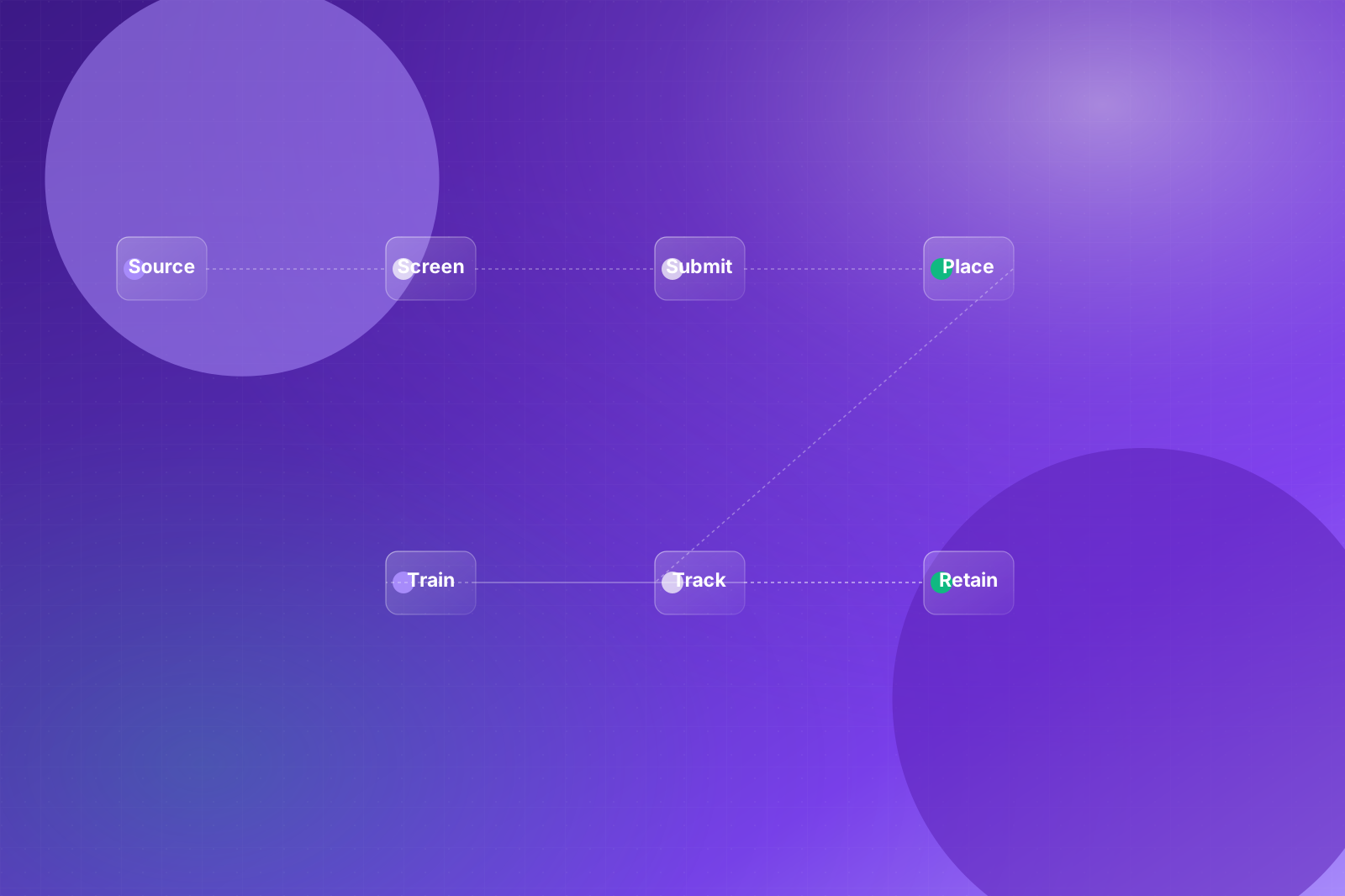
Here is every stage, decision point, and quality gate, in order.
Stage 1 — Intake and requisition deconstruction
Read the requisition. Then ignore it and ask the real questions.
A job description is a starting point, not a specification. It tells you what the role is called and what skills the author thinks they need. It does not tell you what the hiring manager actually cares about, what the last person in the role got wrong, or what success looks like in 90 days.
Every search at 3i People begins with a structured intake conversation — with the hiring manager directly where possible, or through careful VMS annotation analysis inside an MSP program. We extract:
- Dealbreakers vs. nice-to-haves. Every JD lists 12 requirements. Usually 4 of them are non-negotiable. We find out which 4.
- Team context. Who is this person working with, and how does the team operate? A candidate who thrives in autonomous environments will fail in a daily-standup, high-accountability team — even if their résumé is identical.
- Prior failed hires. What happened to the last candidate who was hired for this role and did not work out? The answer almost always contains the actual dealbreaker that did not make it into the JD.
- Comp band and flexibility. Not just the published range, but whether there is flex at the top for an exceptional candidate — and whether the range reflects the current market or last year's budget.
- Timeline drivers. Is there a project deadline, a headcount freeze approaching, or a stakeholder who needs to see hiring progress? Timeline affects how we prioritize the shortlist.
This intake takes 20 to 40 minutes. It is non-negotiable, even in high-volume programs where the cadence pressure is high. Skipping intake is the fastest way to produce submittals that look right on paper and fail in person.
Stage 2 — Leap Tiger™ match run
Let the platform surface candidates. Then apply judgment.
After intake, the requisition — with all of its annotated context — is fed into Leap Tiger™, our proprietary AI talent platform. The platform builds a weighted fit profile from 40+ attributes and scores our candidate database against that profile. It does not produce a ranked list of candidates; it produces a ranked list of candidate-role pairs, scored against this specific requisition at this specific client.
What does the recruiter do with the shortlist? Not take it at face value. The top-scored candidates get reviewed for:
- Recency of relevant experience. A candidate who did network engineering at a telecom carrier five years ago and has been doing cloud infrastructure since is not the same as someone doing it today.
- Compensation expectations vs. the confirmed band. A candidate who is a 97% technical fit but is $40K above the comp ceiling is not a viable submittal — it is a waste of the hiring manager's time.
- Availability and timing. Is this person genuinely available, or are they passively entertaining calls while under a 90-day notice period?
- Placement history signals. Our database includes structured notes from prior placements and screens. A candidate who withdrew from a similar role two years ago, and the notes say "declined due to remote policy," is not a fit for a five-day-a-week onsite role — regardless of technical score.
The output of this stage is a short list of 6 to 10 candidates worth a qualification call — not 40 résumés to sort through.
Stage 3 — Candidate qualification
The screen that makes or breaks your submitted-to-interview rate.
This is where 40% submitted-to-interview rates are built or lost. Most staffing firms run a 15-minute résumé review call: "Walk me through your background, are you interested in this role, what are your salary expectations?" That is not a qualification screen. That is a warm-up for a phone interview.
Our qualification screen is structured and runs 45 to 60 minutes per candidate. It covers:
- Behavioral questions mapped to the specific role. We are not running a generic competency screen. We are asking about situations directly relevant to the challenges the hiring manager flagged in intake. If the manager said the last person failed on cross-functional collaboration, we are probing for that specifically.
- Compliance screening. For regulated industries — financial services, healthcare, telecom — we screen for certifications, clearances, background check eligibility, and licensing requirements before submission. A candidate who fails the compliance screen after being submitted costs the hiring manager 60 to 90 minutes of interview time they will not get back.
- Compensation calibration. Not "are you open to $X" but: "here is the confirmed band for this role, here is what we know about comparable roles in this market, is this the right conversation for where you want to be in 12 months?" We are not hiding the number; we are having an honest conversation about whether the comp is aligned before the hiring manager invests their time.
- Genuine interest assessment. Is this candidate applying because they are genuinely interested in this kind of work, or because they are testing the market? We ask directly. The answer affects how we present them and how much preparation time we invest before submission.
At the end of stage 3, the recruiter writes structured qualification notes — not a paragraph summary, but a field-by-field document covering technical fit, behavioral signals, comp alignment, availability, and any open questions. These notes accompany every submission.
"We submit four candidates who are ready to start, not twelve who are available. The hiring manager's time is the constraint we optimize for — not our submit count."
Stage 4 — Submission and stakeholder preparation
A submission is not a résumé drop. It is a briefing package.
What goes into a 3i People submission:
- The résumé, formatted for readability — not the candidate's original format, which is almost always optimized for keyword scanners, not human readers.
- A match rationale. A one-page summary of why this candidate fits this role — specific to the intake notes, not a generic skills summary. If the hiring manager said cross-functional collaboration was critical, the match rationale explains how this candidate demonstrated it.
- Qualification screen notes. The full structured notes from stage 3. Hiring managers who receive these notes close roles faster because they arrive at the interview already knowing what to probe.
- Compliance status. For regulated-industry clients, a clear notation of which certifications and clearances have been verified, and which remain pending.
Before the submission goes in, it passes an internal quality gate: a second recruiter reviews the match rationale and flags any gaps between the intake requirements and what the submission package documents. If there is a gap we cannot explain, the candidate goes back to stage 3 or is removed from consideration.
After submission, we brief the hiring manager on what to expect in the interview — the candidate's strongest areas, the questions worth asking, and any areas that were flagged in the screen as worth probing further. This takes five minutes and increases the useful signal the hiring manager gets from the interview by a measurable amount.
Stage 5 — Interview support and debrief
Stay in the loop through the decision, not just the submit.
Most staffing firms go quiet after submitting. They wait for the hiring manager to schedule an interview, then re-emerge to ask for feedback. That is not support; it is follow-up.
During the interview stage, the 3i recruiter is active in three directions simultaneously:
With the candidate: Interview preparation 24 hours before the scheduled call — specifics about the company, the team, the manager's background, what they are likely to focus on. Post-interview debrief within two hours of completion: what did you learn, are you still interested, how does this rank against your other conversations? The post-interview debrief is not optional; it is where we catch declining interest before it becomes a withdrawn candidate.
With the hiring manager: Post-interview debrief — what signals did you see, what gaps remain, where does this candidate rank? This conversation tells us whether to accelerate the search, adjust the profile, or prepare for an offer conversation. It also surfaces information that changes how we prepare the next round of candidates.
Internally: The debrief information feeds back into the Leap Tiger™ run for remaining open slots on the same requisition. If the hiring manager says the candidate was technically strong but lacked the stakeholder communication skill they need, we adjust the attribute weighting for the next shortlist run.
Stage 6 — Offer and close
The offer is not the finish line. It is the beginning of the most fragile stage.
The period between verbal offer and signed offer letter is where placements fall apart. Counteroffers, cold feet, competing offers, and start-date anxiety all cluster in this window. Our close process is designed for this:
- Comp negotiation guidance. We present the offer with full context — market range, the hiring manager's flexibility, and our read on whether the candidate will accept. We do not just relay a number; we frame it in a way that increases acceptance probability without misrepresenting either side.
- Counteroffer coaching. If the candidate's current employer makes a counteroffer, we work through it with them — not to dismiss it, but to help them evaluate it honestly. A candidate who takes a counteroffer and is back on the market in six months is not a win for them or for the hiring manager.
- Start-date confirmation and check-in cadence. Between acceptance and start date, we maintain contact — one check-in at day 3 post-acceptance, one at day 7, one the week before start. These check-ins catch cold feet before the candidate ghosts the start date.
- 90-day follow-up. After the placement starts, we check in with both the hiring manager and the candidate at the 30-day and 90-day mark. This is not a formality. The 90-day check-in is where we learn whether the placement is actually working — and that feedback shapes how we run the next search.
Why this process produces the numbers it does
The 40% submitted-to-interview rate does not come from submitting fewer candidates. It comes from stage 3: structured qualification screens that surface fit signals before the hiring manager's time is spent.
The 48% interviewed-to-offer rate does not come from lucky candidate selection. It comes from stages 4 and 5: submission packages that arrive with context, and interview debrief loops that adjust the search in real time.
The retention performance that clients like Cox Communications and SiteOne Landscape Supply have observed over 14 and 9 years respectively comes from stage 6: the 90-day follow-up that turns placement into an ongoing accountability loop, not a transaction.
None of these outcomes are possible if any stage is skipped. The 52-week training program our recruiters complete is designed to make every one of these stages second nature — not a checklist to follow, but a discipline to apply with judgment.
If you want to see this process applied to your open requisitions, schedule a 15-min consult and we will walk through your specific requirements — no slide deck, no generic pitch.