
In most industries, a fast staffing vendor looks like a good staffing vendor. The logic makes sense on the surface: if you submit candidates quickly, you must have a deep pipeline. But in financial services, healthcare, and telecom — three of the most heavily regulated verticals in the U.S. economy — that logic breaks down the moment a candidate hits a compliance screen.
A fast submit that fails FINRA background verification, HIPAA training requirements, or telecom licensing checks does not save time. It costs time — typically 18 days of pipeline reset, re-sourcing, and stakeholder re-alignment. When that happens repeatedly across a high-volume requisition program, the compounding effect is severe. The hiring manager loses confidence in the vendor. The MSP program manager starts downweighting that vendor's submittals. The vendor's effective fill ratio collapses — even though their submit speed looks fine in the dashboard.
This is the problem with optimizing for speed. Speed is visible. Fill ratio is what actually matters.
What fill ratio actually measures
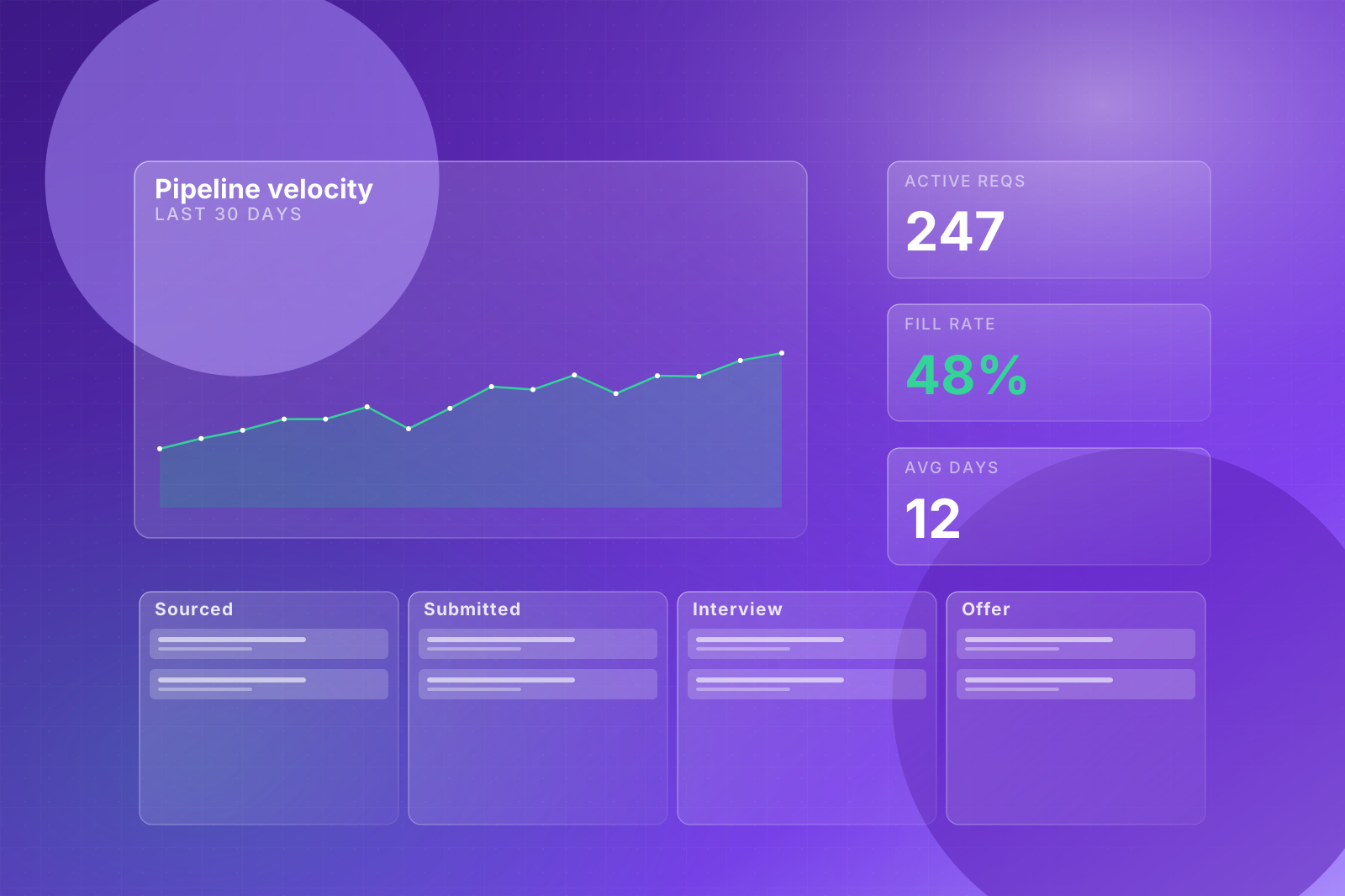
Fill ratio is a simple calculation: requisitions where a placement was completed divided by total requisitions assigned to a vendor. If a vendor receives 100 open roles and successfully places a candidate in 48 of them, their fill ratio is 48%.
That number is deceptively powerful because it captures everything that goes wrong in the sourcing-to-placement pipeline: candidates who fail compliance screens, submittals that never reach interview, offers that are declined, and placements that fall through before the start date. All of those failure modes pull fill ratio down. A vendor who submits aggressively but converts poorly will have a high submit volume and a low fill ratio — and the client pays the cost of the gap.
Fill ratio is the purest measure of vendor reliability because it is outcome-based, not activity-based. Submit volume measures activity. Fill ratio measures results. In regulated industries, where every failed candidate consumes recruiter time, hiring-manager time, and compliance-team time, the distinction is the difference between a productive vendor relationship and a frustrating one.
The compliance screening problem
Regulated industries add screening stages that most staffing vendors do not anticipate until after submission. Financial services roles may require FINRA Series license verification, SOX-related background checks, or AML/KYC training certifications. Healthcare roles may require HIPAA training completion, HITRUST familiarity, or specific clinical credentialing. Telecom roles — particularly those supporting federal or utility-adjacent infrastructure — may require security clearances or FCC licensing documentation.
A vendor that submits without pre-screening for these requirements is essentially passing the compliance work downstream to the hiring manager's team, the MSP coordinator, or the client's HR department. That is not a staffing service — it is résumé forwarding.
At 3i People, compliance pre-screening happens before a candidate enters the submission queue. Our recruiters are trained on the specific compliance requirements of each vertical we operate in, and that training is part of the 52-week program that every recruiter completes before managing a regulated-industry account. When a candidate is screened for a financial services role, the recruiter verifies compliance readiness — not just technical fit — before the submission is prepared.
The result is less noise in the hiring manager's pipeline. Fewer candidates who look good on paper but fail at the background stage. Higher per-submit conversion, which means higher fill ratio — and fewer wasted hours on both sides of the transaction.
"SiteOne's procurement team did not name us their top staffing vendor because we submitted first. They named us because 48 of every 100 requisitions we touched resulted in a placed, retained employee."
The math on fast-fail submittals
Consider two vendors competing on the same regulated-industry program. The program coordinator sees two very different performance profiles by the end of the quarter.
Vendor A submits 10 candidates within 24 hours of receiving a requisition. The submit speed looks impressive in the VMS dashboard. But 7 of the 10 fail the compliance pre-screen — they either lack the required certifications, have gaps in their background history, or their comp expectations are 30% above the approved range. Of the 3 remaining candidates, 2 reach interview. One receives an offer. Fill ratio: 10%.
Vendor B submits 4 candidates within 48 hours. The submit speed is slower. But all 4 clear the compliance pre-screen, because the recruiter ran those checks before submission. All 4 reach interview. Two receive offers. Fill ratio: 50%.
Which vendor is more productive for the hiring team? Vendor A generated 10 résumés for the coordinator to process, 10 compliance checks to run, and 10 candidates to reject or advance — all to produce one hire. Vendor B generated 4 résumés, 4 clean compliance checks, and 4 interviews — to produce two hires. Vendor B took 24 hours longer to submit and delivered five times the fill ratio.
This is not a hypothetical. It is the operating model that produced our 48% fill ratio at SiteOne and our sustained top-3 ranking across 30+ vendors at Cox Communications over 14 years. The math works — it just requires a different discipline than the one most VMS programs inadvertently reward.
What to look for in a staffing partner for regulated industries
If you manage hiring in financial services, healthcare, or telecom, the vendor evaluation questions that predict fill ratio performance are different from the ones that predict submit speed. Here is what to probe:
- Compliance pre-screening process. Ask the vendor to describe specifically how they verify compliance readiness before submission. If the answer is "we check the résumé for certifications," that is not a pre-screening process. A genuine process involves structured verification steps — license lookup, background flag review, certification expiration check — before the candidate enters the submission queue.
- Vertical-specific knowledge. FINRA, HIPAA, HITRUST, and SOX each have specific implications for candidate screening. A recruiter who does not know what a Series 7 license is should not be sourcing for a broker-dealer. Ask the vendor which compliance frameworks their recruiters are trained on and how that training is maintained.
- Prior placement proof in the vertical. Fill ratio claims are easy to make. Ask for specific client names, engagement durations, and fill ratios by vertical — not aggregate numbers. A vendor who has maintained a 12% fill ratio at a major telecom carrier for 14 years has demonstrated something that no pitch deck can replicate.
- Fill ratio benchmarks by vertical. Industry averages vary. A 20% fill ratio in a highly specialized security clearance program is strong. A 20% fill ratio in a general IT staffing program at a commercial enterprise is weak. Ask the vendor how their fill ratio compares to the program average — not to an abstract benchmark.
The bottom line
Speed is a feature. Fill ratio is the product. In an unregulated, low-stakes hiring environment, the difference may not matter much — fast submittals that miss occasionally can be tolerated when the cost of a miss is low. In regulated industries, where every failed candidate carries downstream compliance, time, and credibility costs, the difference is measured in months of hiring setback and millions in productivity loss.
The vendors who sustain high fill ratios in regulated verticals are not the ones with the largest candidate databases. They are the ones whose recruiters understand compliance requirements before submitting, not after. They are the ones who measure their performance by placements completed, not résumés forwarded.
If you want to see what a calibrated, compliance-first sourcing process looks like in practice, read the Cox Communications case study or the SiteOne Landscape Supply case study — or schedule a 15-min consult and we will walk through the process against your specific requisitions.